


Gamay.
Colour : intense ruby-red tinged with purple.
Nose : bright black fruit aromas redolent of blackberries and blackcurrant.
Mouth : fresh and yet round, with very pleasant fruity flavours emphasized by supple tannins that give great lenght to the wine.
Enjoy with cold meats, snails, roasted meats and mild cheeses.
To best enjoy its flavours, serve ideally between 14 and 15°C. / 57-59°F.
Drink young, can be kept from 2 to 3 years.
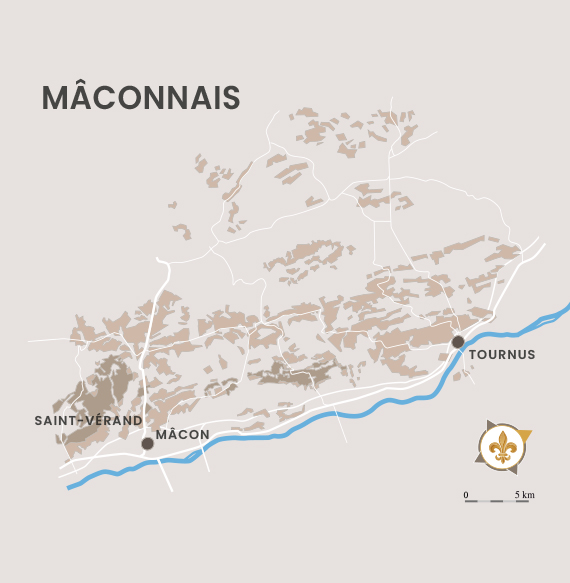
The Mâconnais region, located in southern Burgundy, stretches for around 40 kilometres between the Côte Chalonnaise and the Solutré rock. Its vineyards, planted on valleys and hillsides between the Saône and Grosne rivers, produce red and rosé wines from Pinot Noir or Gamay Noir à Jus Blanc grapes. The Mâcon appellation covers 350 hectares for reds and rosés, and 3,800 hectares for whites. It can be supplemented by the name of the commune of origin.
- Predominantly limestone soils with granite outcrops.
- South-east and east facing.
- Gentle to steep slopes.
- Altitude between 100 and 400 metres.
The grapes are destemmed for maximum fruitiness. Maceration and fermentation take place in stainless steel vats at a controlled temperature (30°C), with punching down of the cap twice a day during alcoholic fermentation and a few pump-overs to extract all the compounds from the grapes. Malolactic fermentation is carried out at 100% to soften the wine and reduce its acidity. In order to obtain fruity aromas, the wine is matured in vats for around 6 months.
The year 2024 in Burgundy was marked by extreme weather conditions, including excessive rainfall and a significant lack of sunshine. These factors led to high disease pressure, particularly downy mildew, complicating the work of winegrowers. Episodes of frost and hail also caused substantial damage, especially in regions such as Chablis and the Auxerrois.
Yields were heavily impacted, with losses reaching up to 70% in certain areas. The Côte Chalonnaise proved more resilient, recording more limited losses. Overall, volumes are well below the usual average, reminiscent of the difficult 2021 harvest.
The late harvest required rigorous sorting to preserve quality. Despite the challenges, the harvested grapes reached excellent ripeness thanks to a sunny spell in September. The reds stand out for their richness and concentration, comparable to great vintages like 2010. The whites, characterized by their elegance, are reminiscent of the 2022 vintage.
Initial tastings reveal promising wines with concentrated aromas and fine structure. This vintage, though quantitatively limited, is shaping up to be a qualitative success.
 PDF file