


Gamay.
Colour : intense ruby-red tinged with purple.
Nose : bright black fruit aromas redolent of blackberries and blackcurrant.
Mouth : fresh and yet round, with very pleasant fruity flavours emphasized by supple tannins that give great lenght to the wine.
Enjoy with cold meats, snails, roasted meats and mild cheeses.
To best enjoy its flavours, serve ideally between 14 and 15°C. / 57-59°F.
Drink young, can be kept from 2 to 3 years.
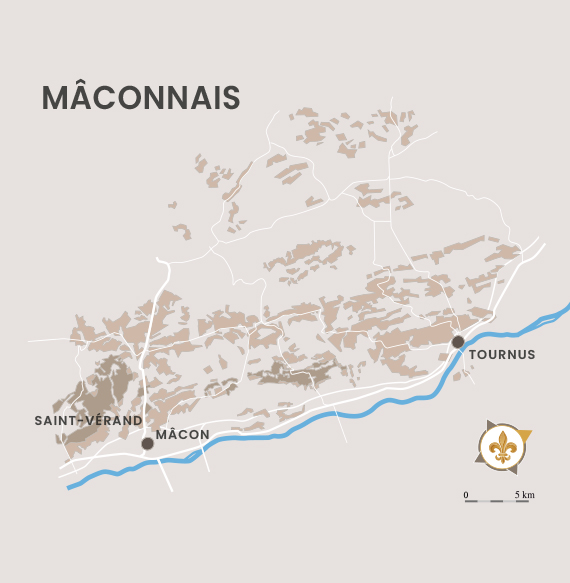
The Mâconnais region, located in southern Burgundy, stretches for around 40 kilometres between the Côte Chalonnaise and the Solutré rock. Its vineyards, planted on valleys and hillsides between the Saône and Grosne rivers, produce red and rosé wines from Pinot Noir or Gamay Noir à Jus Blanc grapes. The Mâcon appellation covers 350 hectares for reds and rosés, and 3,800 hectares for whites. It can be supplemented by the name of the commune of origin.
- Predominantly limestone soils with granite outcrops.
- South-east and east facing.
- Gentle to steep slopes.
- Altitude between 100 and 400 metres.
The grapes are destemmed for maximum fruitiness. Maceration and fermentation take place in stainless steel vats at a controlled temperature (30°C), with punching down of the cap twice a day during alcoholic fermentation and a few pump-overs to extract all the compounds from the grapes. Malolactic fermentation is carried out at 100% to soften the wine and reduce its acidity. In order to obtain fruity aromas, the wine is matured in vats for around 6 months.
From November 2021 to January 2022, there was abundant rain, followed by cool months in February and March, which delayed budding and prevented frost. May was particularly warm, favouring good flowering, but June was marked by hot mornings and violent thunderstorms in the afternoon. In July, intense heat led to water stress, slowing down the ripening of the vines, depending on the plot.
Work in the vines influenced the results, with some plots producing an excellent vintage, while others suffered from dehydration. Most of the harvest began at the beginning of September, with beneficial rain falling at the end of the day or at night, allowing the grapes to offer a good balance between sugar content and acidity.
Harvesting finished in mid-September, with production close to normal despite variable volumes. The 2022 wines have notes of ripe fruit, while retaining their freshness. They are generous and well-balanced.
 PDF file