


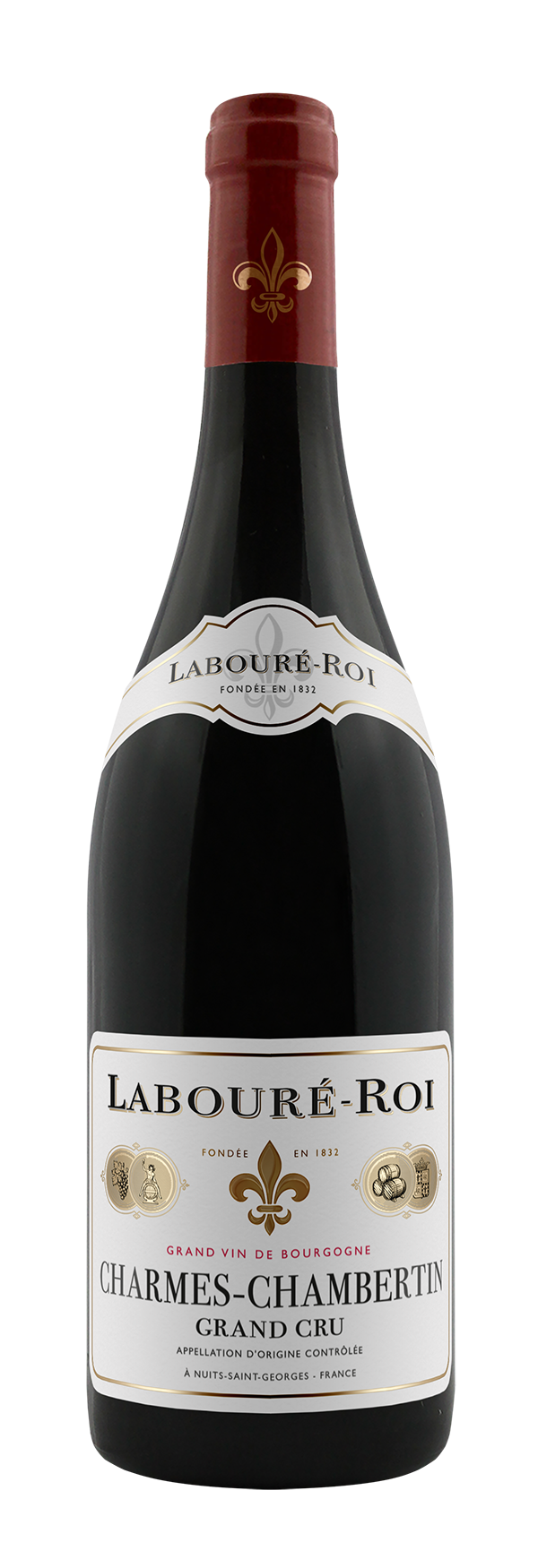
Pinot Noir.
Colour: Deep ruby red with subtle garnet highlights.
Bouquet: Rich and expressive, offering aromas of spice, mandarin zest, fresh hazelnut, liquorice and violet.
Palate: Round, rich and complex, revealing flavours of small red and black berries intertwined with delicate oak notes. The tannins are silky and beautifully integrated, creating a perfectly balanced wine.
An excellent match for honey-glazed roast duck. It also pairs beautifully with poultry, roasted meats and game dishes. For cheese lovers, it is particularly enjoyable with traditional Burgundy cheeses such as Époisses.
Best served at around 15°C (59°F).
This Grand Cru will cellar gracefully for 8 to 10 years, and even longer under optimal storage conditions.
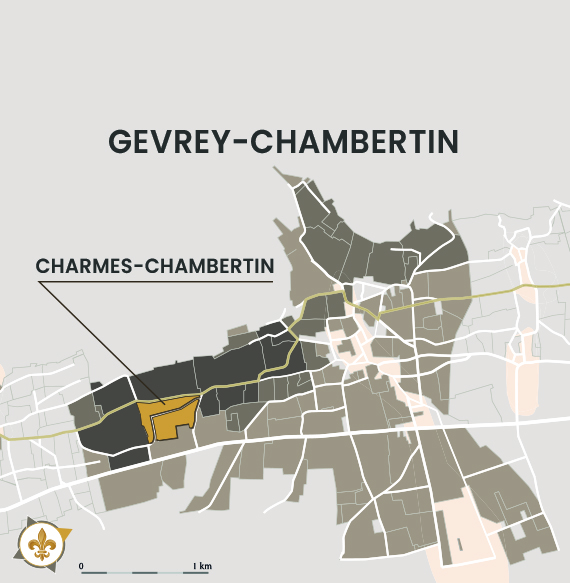
A Grand Cru appellation of the Côte de Nuits, located in the commune of Gevrey-Chambertin. The vineyard lies just below another prestigious Grand Cru, Chambertin, on the southernmost edge of the Gevrey-Chambertin appellation. Covering approximately 30 hectares, Charmes-Chambertin is the largest Grand Cru vineyard in Gevrey-Chambertin. The east-facing vines are planted on gentle slopes at elevations ranging from 260 to 280 metres above sea level. The soils are particularly stony, containing volcanic stones, with the bedrock lying very close to the surface—between 25 and 40 centimetres deep. The name“Charmes” is believed to derive from a small grove of hornbeam trees once planted by monks and now long disappeared.
Harvested by hand, the Pinot Noir grapes are carefully sorted and fully destemmed before being transferred by gravity into fermentation vats. Maceration lasts approximately three weeks, with punch-downs carried out at varying frequencies according to the vintage profile and extraction needs. The wine is then matured for 15 months in oak barrels, including 20% new oak, bringing structure, depth and complexity while preserving the purity of the fruit.
The year 2024 in Burgundy was marked by extreme weather conditions, with excessive rainfall and a significant lack of sunshine. These factors led to heavy disease pressure, particularly downy mildew, complicating the work of the winegrowers. Frost and hail also caused significant damage, particularly in regions such as Chablis and Auxerrois.
Yields were severely affected, with drops of up to 70% in some areas. The Côte Chalonnaise held up better, with more limited losses. Overall, volumes are well below the usual average, a reminder of the difficult harvests in 2021.
The late harvest necessitated rigorous sorting to preserve quality. Despite the challenges, the grapes harvested reached good ripeness thanks to a sunny spell in September. The reds stand out for their richness and concentration, comparable to great vintages such as 2010. The elegant whites are reminiscent of 2022.
Initial tastings reveal promising wines, with concentrated aromas and a fine structure. Although limited in quantity, this vintage promises to be a qualitative success.
 PDF file