


Pinot Noir.
Colour: Deep ruby red with subtle garnet highlights.
Bouquet: Rich and expressive, offering aromas of spice, mandarin zest, fresh hazelnut, liquorice and violet.
Palate: Round, rich and complex, revealing flavours of small red and black berries intertwined with delicate oak notes. The tannins are silky and beautifully integrated, creating a perfectly balanced wine.
An excellent match for honey-glazed roast duck. It also pairs beautifully with poultry, roasted meats and game dishes. For cheese lovers, it is particularly enjoyable with traditional Burgundy cheeses such as Époisses.
Best served at around 15°C (59°F).
This Grand Cru will cellar gracefully for 8 to 10 years, and even longer under optimal storage conditions.
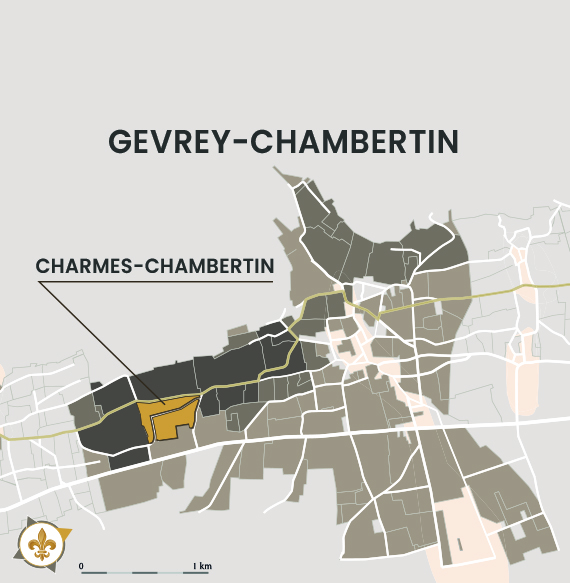
A Grand Cru appellation of the Côte de Nuits, located in the commune of Gevrey-Chambertin. The vineyard lies just below another prestigious Grand Cru, Chambertin, on the southernmost edge of the Gevrey-Chambertin appellation. Covering approximately 30 hectares, Charmes-Chambertin is the largest Grand Cru vineyard in Gevrey-Chambertin. The east-facing vines are planted on gentle slopes at elevations ranging from 260 to 280 metres above sea level. The soils are particularly stony, containing volcanic stones, with the bedrock lying very close to the surface—between 25 and 40 centimetres deep. The name“Charmes” is believed to derive from a small grove of hornbeam trees once planted by monks and now long disappeared.
Harvested by hand, the Pinot Noir grapes are carefully sorted and fully destemmed before being transferred by gravity into fermentation vats. Maceration lasts approximately three weeks, with punch-downs carried out at varying frequencies according to the vintage profile and extraction needs. The wine is then matured for 15 months in oak barrels, including 20% new oak, bringing structure, depth and complexity while preserving the purity of the fruit.
From November 2021 to January 2022, there was abundant rain, followed by cool months in February and March, which delayed budding and prevented frost. May was particularly warm, favouring good flowering, but June was marked by hot mornings and violent thunderstorms in the afternoon. In July, intense heat led to water stress, slowing down the ripening of the vines, depending on the plot.
Work in the vines influenced the results, with some plots producing an excellent vintage, while others suffered from dehydration. Most of the harvest began at the beginning of September, with beneficial rain falling at the end of the day or at night, allowing the grapes to offer a good balance between sugar content and acidity.
Harvesting finished in mid-September, with production close to normal despite variable volumes. The 2022 wines have notes of ripe fruit, while retaining their freshness. They are generous and well-balanced.
 PDF file