


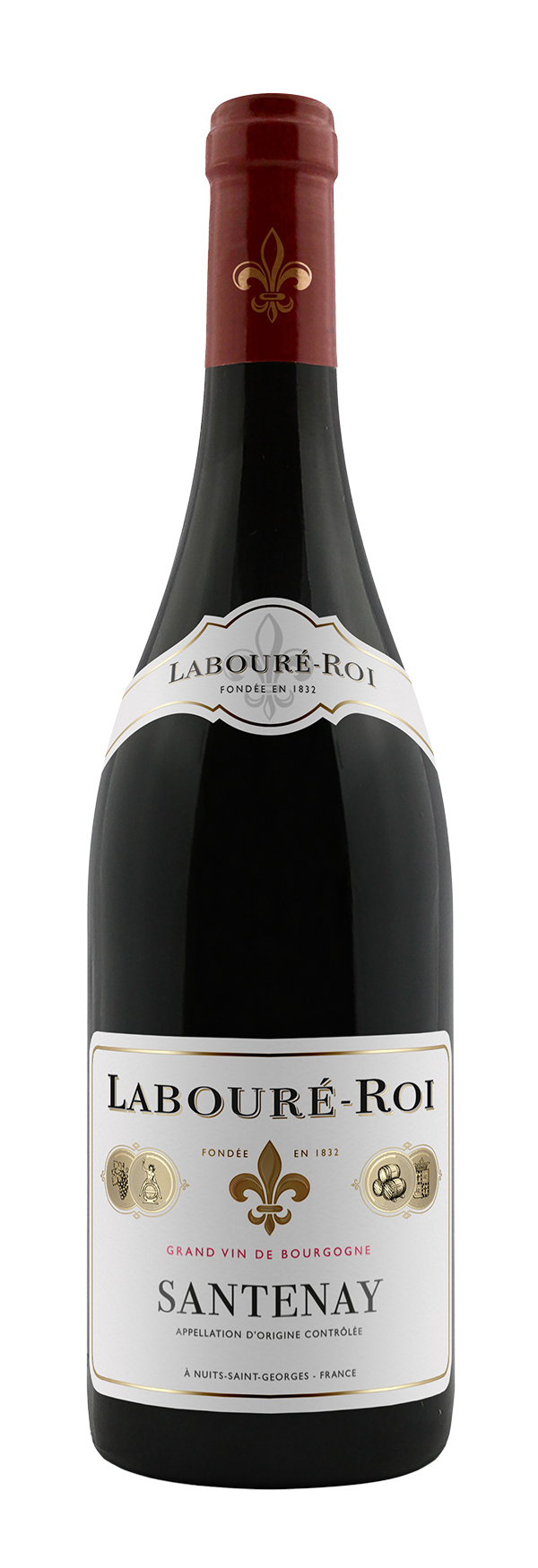
Pinot Noir.
Colour: Ruby red robe.
Bouquet: Nice nose of red cherrie and plum.
Palate: Fresh attack with a lot of fruit, black berries and a hint of liquorice. Firm tannins but well balanced, chewy taste, full bodied. Very long persistency.
Drink with marinated meat dishes, small game, poultry, a braised beef, lamb and cheeses.
Should be served at a cellar temperature of about 15-16°C. (60°F.)
Will easily age 5 to 6 years in the cellar in good storage conditions.
The Appellation d'Origine Contrôlée was established in 1937. Nearly 85% of the wine produced is red and just over 15% is white.
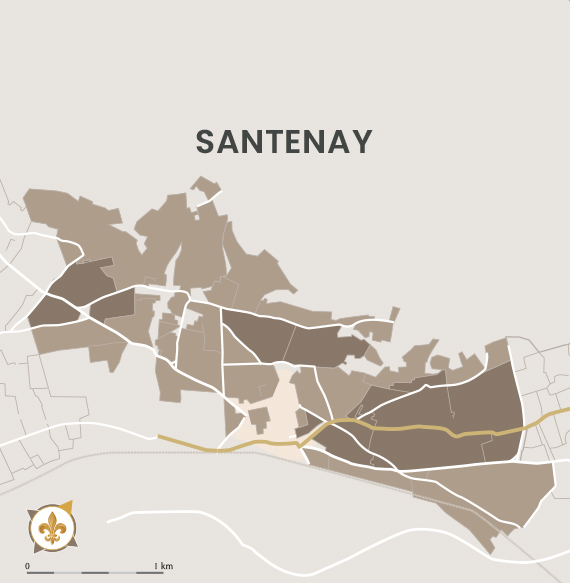
From water nymph to wine god, Santenay has a dual vocation: spa and wine. In the very south of the Côte de Beaune, in this commune and in Remigny in the continuity of the terroir, this wine presents sensitive nuances according to the hillside. Santenay has several towns and hamlets. From the top of Mont de Sène and Montagne des Trois Croix, the view stretches far and wide, and human occupation dates back to prehistoric times. The castle is linked to the memory of the Dukes of Burgundy. The Sorine windmill is also part of the history of this commune.
Hand-picked, the grapes are sorted in the vineyard and then in the winery. The grapes are then destemmed and crushed before being put into thermoregulated vats. Vatting lasts 20-25 days. Vinification begins with cold maceration (8-10°C. / 46-50°F.) for 5-6 days, followed by fermentation with the introduction of Burgundy yeasts, with daily pumping over and punching down of the cap. The wine is then matured in oak barrels (30% new) for 12 months.
The year 2024 in Burgundy was marked by extreme weather conditions, with excessive rainfall and a significant lack of sunshine.
These factors encouraged high disease pressure, notably downy mildew, complicating the winemakers' work. Episodes of frost and hail also caused significant damage, particularly in regions like Chablis and the Auxerrois. Yields were heavily impacted, with drops of up to 70% in certain areas. The Côte Chalonnaise resisted better, recording more limited losses. Overall, volumes are well below the usual average, reminiscent of the difficult 2021 harvests.
The late harvest required rigorous sorting to preserve quality. Despite the challenges, the harvested grapes reached great maturity thanks to a sunny period in September. The reds stand out for their richness and concentration, comparable to great vintages like 2010. The whites, elegant, are reminiscent of those from 2022.
Early tastings reveal promising wines, with concentrated aromas and a fine structure. This vintage, although quantitatively limited, promises to be a qualitative success.
 PDF file