


Pinot Noir.
Colour: Attractive purple-mauve, even black cherry colour.
Nose: Its bouquet is reminiscent of rose petals, peony, violet and red fruits with a hint of liquorice.
Palate: Intense and deep attack, supported by firm but discreet tannins. Supple structure, fine texture and a lingering finish with notes of blueberry.
It is perfect with small game, veal and braised beef, Asian-style glazed and caramelised poultry, or a beautiful platter of Burgundy cheeses.
Serve ideally at a temperature of 16 to 18 °C. (60-64°F.).
Already enjoyable to drink now, this Premier Cru will easily keep for up to 10 years in the cellar, or even longer in the right conditions.
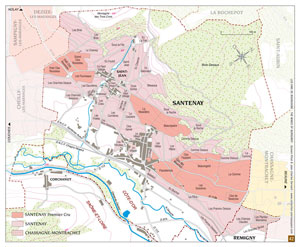
At the southern end of the Côte de Beaune, the Santenay appellation embodies both a thermal and wine-growing tradition. Spread over the communes of Santenay and Remigny, it produces wines with diverse expressions depending on the exposure of the hillsides. The vineyard covers 330 hectares, including 120 hectares classified as Premier Cru, spread over three distinct areas.
This climat, located in the north of the appellation, consists of two parcels on a hillside not far from Chassagne-Montrachet. The vines are south-east facing and benefit from predominantly clay soil. The name probably comes from the fact that it was pleasant to spend time working on these parcels.
Harvested by hand, the Pinot Noir grapes are sorted on arrival at the winery and completely destemmed. Vinification takes place in vats: 4 to 5 days of cold maceration (8 to 10°C maximum), followed by 15 days of fermentation with punching down and pumping over twice a day.
The wines are then placed in 228-litre oak barrels (20% new barrels) for around 15 months of ageing.
The year 2024 in Burgundy was marked by extreme weather conditions, with excessive rainfall and a significant lack of sunshine. These factors led to heavy disease pressure, particularly downy mildew, complicating the work of the winegrowers. Frost and hail also caused significant damage, particularly in regions such as Chablis and Auxerrois.
Yields were severely affected, with drops of up to 70% in some areas. The Côte Chalonnaise held up better, with more limited losses. Overall, volumes are well below the usual average, a reminder of the difficult harvests in 2021.
The late harvest necessitated rigorous sorting to preserve quality. Despite the challenges, the grapes harvested reached good ripeness thanks to a sunny spell in September. The reds stand out for their richness and concentration, comparable to great vintages such as 2010. The elegant whites are reminiscent of 2022.
Initial tastings reveal promising wines, with concentrated aromas and a fine structure. Although limited in quantity, this vintage promises to be a qualitative success.
 PDF file