


Chardonnay.
Colour: Pale gold yellow colour with green reflects.
Bouquet: The bouquet is very elegant offering aromas of white flowers and mineral notes, delicately woody.
Palate: The palate charms with its clarity, balanced freshness, and smooth roundness. Floral and fruity notes mingle with a touch of oak, unveiling a bold yet elegant character full of personality.
This elegant white Burgundy will be delicious on its own, as an aperitif, but also with grilled salmon, crustaceans and white poultry.
Serve at a temperature of around 14°C. (57°F).
Can be kept in the cellar and appreciated from 5 to 8 years after the vintage.
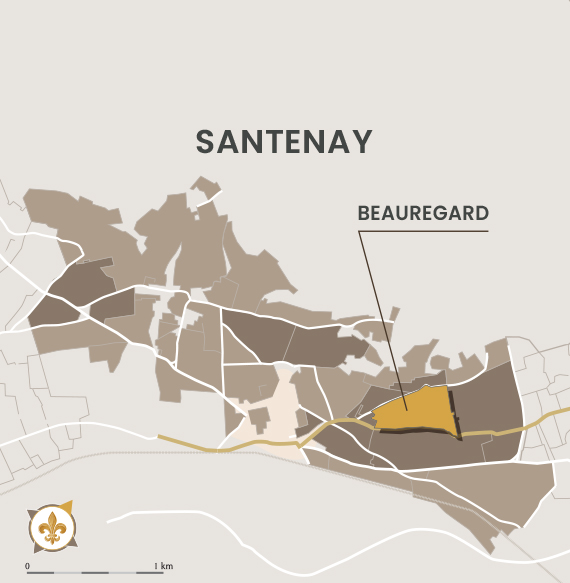
Located at the southern tip of the Côte de Beaune, the Santenay appellation spans the communes of Santenay and Remigny, offering wines with varied profiles depending on the slope exposure. The vineyard extends over 330 hectares, including 120 hectares of Premier Cru across three distinct zones.
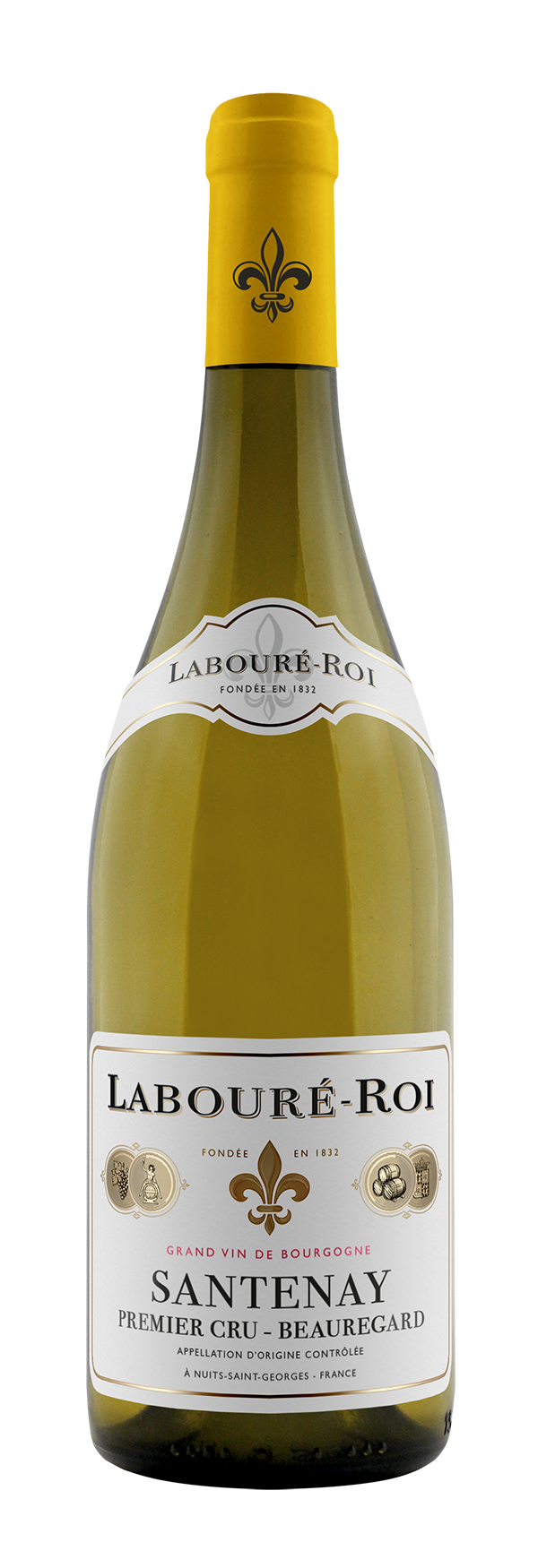
Santenay Premier Cru Beauregard is among the appellation’s most esteemed climats. Situated near the vineyards of Chassagne-Montrachet, its name, meaning “beautiful view,” reflects its elevated position overlooking the Saône plain. Planted with Chardonnay, the old vines thrive in a stony clay-limestone soil, contributing to the finesse and character of the wines.
Harvested by hand, the grapes are sorted and then quickly pressed before being rapidly transferred to temperature-controlled stainless steel vats for cold settling, followed, after 24 hours, by racking to extract the clear juice laden with fine lees. These juices are transferred directly to oak barrels where alcoholic fermentation begins under the influence of selected Burgundy yeasts. Ageing continues for 12 months in these barrels (35% of which are new) and on fine lees with regular stirring to ‘nourish’ the wine.
The year 2024 in Burgundy was marked by extreme weather conditions, with excessive rainfall and a significant lack of sunshine. These factors led to heavy disease pressure, particularly downy mildew, complicating the work of the winegrowers. Frost and hail also caused significant damage, particularly in regions such as Chablis and Auxerrois.
Yields were severely affected, with drops of up to 70% in some areas. The Côte Chalonnaise held up better, with more limited losses. Overall, volumes are well below the usual average, a reminder of the difficult harvests in 2021.
The late harvest necessitated rigorous sorting to preserve quality. Despite the challenges, the grapes harvested reached good ripeness thanks to a sunny spell in September. The reds stand out for their richness and concentration, comparable to great vintages such as 2010. The elegant whites are reminiscent of 2022.
Initial tastings reveal promising wines, with concentrated aromas and a fine structure. Although limited in quantity, this vintage promises to be a qualitative success.
 PDF file