


Pinot Noir.
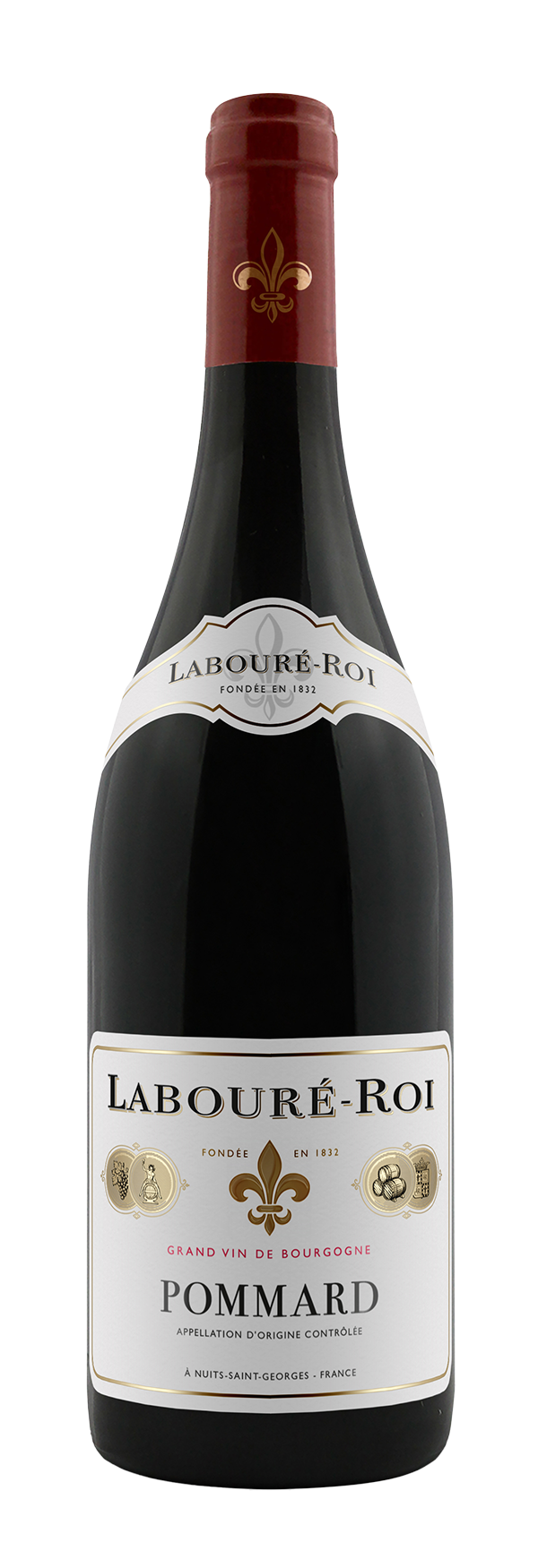
Colour: Beautiful dark ruby.
Bouquet: Rich, quite powerful, showing a certain concentration mixing berries (blackcurrant, currant, blackberry, cherry stone), toasted woody notes, some peppery and leather notes.
Palate: chewy tannins well supported by a velvety structure and complex, fruity, spicy and animal flavours. Very good length.
It's the perfect companion for tasty, sophisticated cuisine: fine beef or lamb, marinated game or a platter of mature cheeses.
Serve ideally between 15°C and 16°C / 59-61°F.
This great Burgundy red will easily keep for 6 to 8 years in the cellar, or even longer depending on the vintage and in the right conditions.
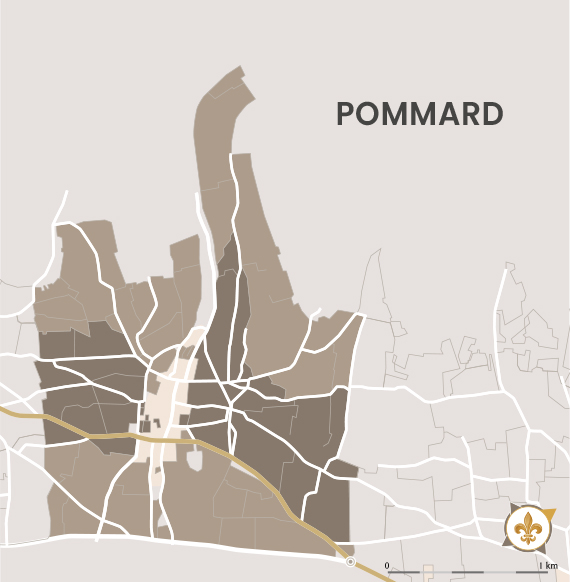
Pommard is one of the most famous villages in the Côte de Beaune, situated 5 km south of the town of Beaune on the route de Grands Crus. The appellation covers 322 hectares and produces only red wines, with 36% of its wines classified as 1er Cru.
On the lower slopes, ancient alluvial deposits, then in the middle of the hillsides, the clay-limestone soils are well drained thanks to a pebbly deposit of rock debris. Further up, we find Oxfordian marl (Jurassic), brown calcareous and brown calcareous soils. Iron oxide sometimes reddens the soil. Facing east and south. Altitude: between 250 and 330 metres.
It is of traditional Burgundian type. Harvested by hand, the grapes are sorted once at the vineyard and then at the wineries as soon as they arrive. After this severe sorting, they are destemmed and crushed and then introduced in thermo-regulated tanks. The vatting lasts from 20 to 25 days. The vinification begins with a cold maceration (8°-10°C) for 5 to 6 days, then the fermentation is carried out with the introduction of Burgundy yeasts, with daily punching down and pumping over. The ageing continues in 228 litres barrels, of which about 30% new barrels for 12 months.
The year 2024 in Burgundy was marked by extreme weather conditions, with excessive rainfall and a significant lack of sunshine. These factors led to heavy disease pressure, particularly downy mildew, complicating the work of the winegrowers. Frost and hail also caused significant damage, particularly in regions such as Chablis and Auxerrois.
Yields were severely affected, with drops of up to 70% in some areas. The Côte Chalonnaise held up better, with more limited losses. Overall, volumes are well below the usual average, a reminder of the difficult harvests in 2021.
The late harvest necessitated rigorous sorting to preserve quality. Despite the challenges, the grapes harvested reached good ripeness thanks to a sunny spell in September. The reds stand out for their richness and concentration, comparable to great vintages such as 2010. The elegant whites are reminiscent of 2022.
Initial tastings reveal promising wines, with concentrated aromas and a fine structure. Although limited in quantity, this vintage promises to be a qualitative success.
 PDF file