


Pinot Noir.
Colour: Deep ruby.
Bouquet: Aromas of cherry and blackcurrant, violets and peony, evolving with age towards undergrowth, fern and spices.
Palate: Full attack of red fruit. Tannins are present and supple. Round and delicate, developing scents of undergrowth, humus and truffle.
Monthélie is the ideal accompaniment to roast poultry, lamb, rabbit and grilled offal such as sweetbreads or andouillette sausage. It also pairs well with meat pies and mild, creamy cheeses such as Brillat-Savarin, Brie or Reblochon.
Serve at a temperature of around 14-17°C. (57-63°F.).
This Burgundy wine can be cellared for 7 to 10 years.
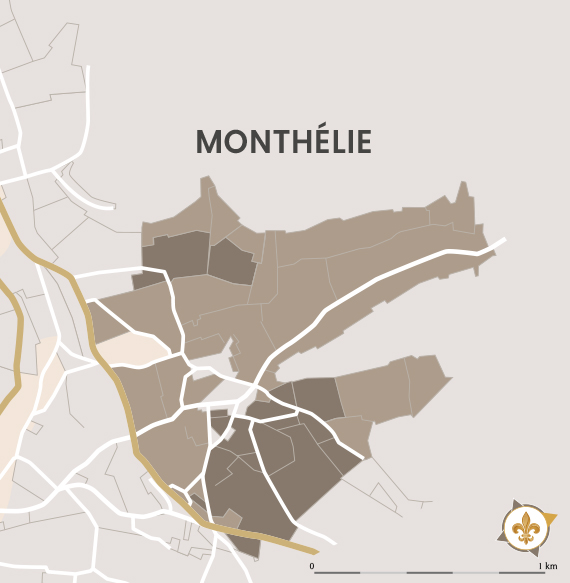
The Monthélie AOC (pronounced Mont'lie) is located on the edge of the Côte de Beaune, between Volnay and Meursault, on a 130-hectare vineyard mainly dedicated to red wines (88%) and comprising 15 Premiers Crus.
The wine-growing landscape is structured around a valley, with vines planted on two hillsides and an alluvial fan. The Auxey-Duresses hillside, with its white Argovian marl exposed to the east, mainly produces red wines. The Volnay hillside, which has a more varied exposure, has red soils rich in iron oxide. The alluvial fan, formed from scree, accounts for 75% of the appellation's production, at an altitude of between 230 and 370 metres.
The grapes are harvested by hand and sorted by hand on arrival at the winery. 100% of the grapes have been destemmed. Vinification for 20 days in vats. Cold maceration for 6 days at 8°C. Nine days of fermentation with punching down of the cap 3 times a day during fermentation at a temperature of 30°C. Pumping over twice a day for 5 days, followed by pressing. Aged for 12 months in oak barrels (30% new oak).
From November 2021 to January 2022, there was abundant rain, followed by cool months in February and March, which delayed budding and prevented frost. May was particularly warm, favouring good flowering, but June was marked by hot mornings and violent thunderstorms in the afternoon. In July, intense heat led to water stress, slowing down the ripening of the vines, depending on the plot.
Work in the vines influenced the results, with some plots producing an excellent vintage, while others suffered from dehydration. Most of the harvest began at the beginning of September, with beneficial rain falling at the end of the day or at night, allowing the grapes to offer a good balance between sugar content and acidity.
Harvesting finished in mid-September, with production close to normal despite variable volumes. The 2022 wines have notes of ripe fruit, while retaining their freshness. They are generous and well-balanced.
 PDF file