


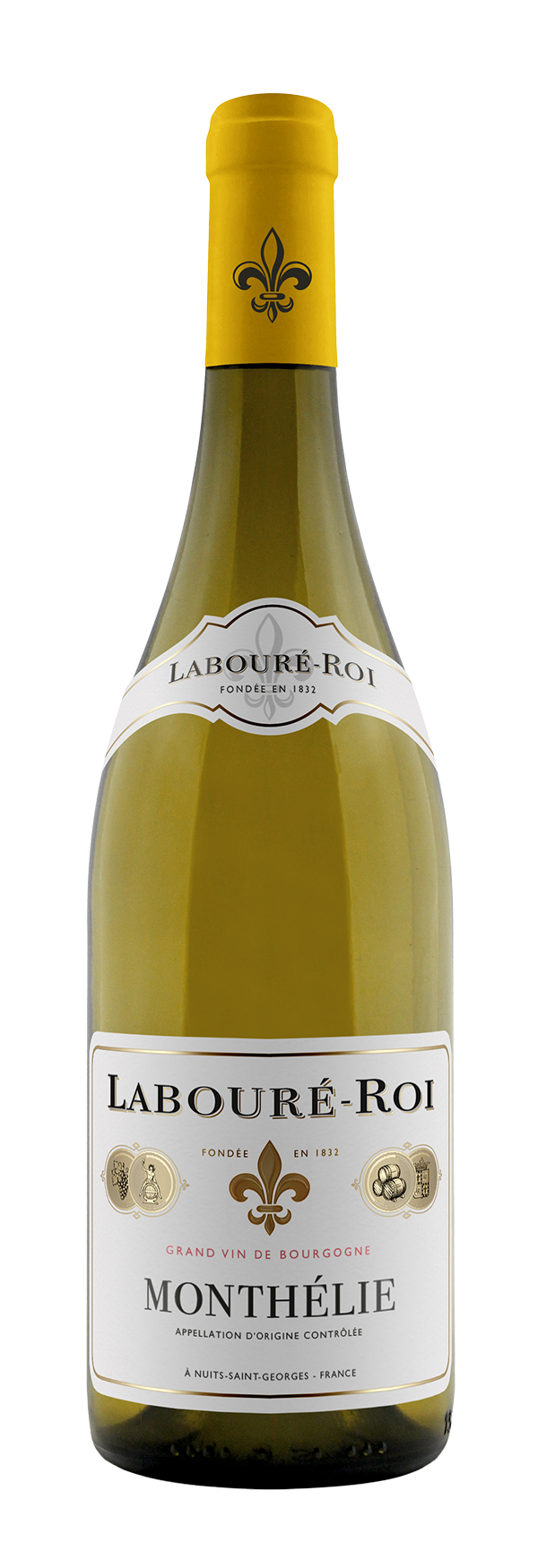
Chardonnay.
Colour: Beautiful straw-yellow colour with golden highlights.
Nose: An expressive bouquet revealing aromas of ripe lemon and white flowers, complemented by elegant mineral and subtle smoky notes.
Palate: Freshness and richness combine harmoniously on the palate, delivering superb balance and flavours of citrus zest.
Its generous texture and rounded character pair beautifully with lightly seared, al dente prawns and fish tagines. For cheese pairings, it is an excellent match for blue cheeses such as the French Roquefort, Bleu de Bresse and Bleu d’Auvergne, while also complementing soft cheeses such as Époisses and Livarot.
Best served between 12°C and 14°C (54°F–57°F).
Will cellar gracefully for 4 to 8 years.
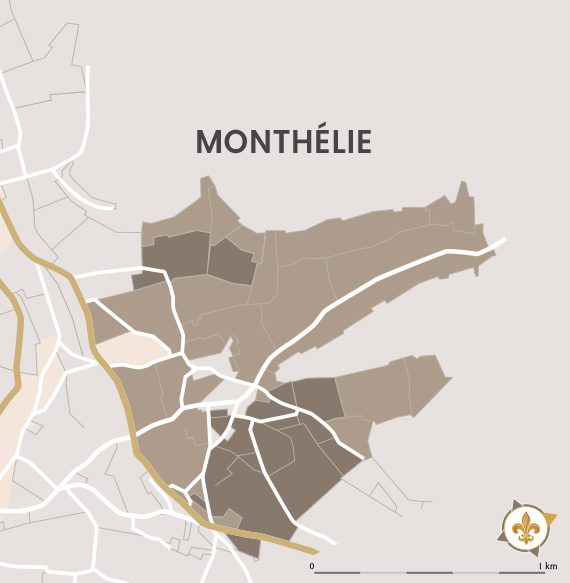
The Monthélie AOC (pronounced Mont’lie) lies on the edge of the Côte de Beaune, between Volnay and Meursault, encompassing 130 hectares of vineyard land, predominantly devoted to red wines (88%) and including 15 Premier Cru climats.
Exposed to the south and south-east, the vineyards are rooted in Bathonian gravelly limestone overlaid with red clay and marl. Monthélie’s vines extend across the “Volnay hillside” and into the Auxey-Duresses valley, where Argovian limestone soils and east- or west-facing slopes prevail, at elevations ranging from 230 to 370 metres above sea level.
The grapes were gently whole-bunch pressed using a pneumatic press in order to obtain musts of the highest possible quality. After 24 hours of settling, the must was transferred to barrel for alcoholic fermentation. The lees were stirred once a week (bâtonnage) to enhance texture, richness and aromatic complexity. The wine was then matured in French oak barrels for 16 months, including 20% new oak.
The year 2024 in Burgundy was marked by extreme weather conditions, with excessive rainfall and a significant lack of sunshine. These factors led to heavy disease pressure, particularly downy mildew, complicating the work of the winegrowers. Frost and hail also caused significant damage, particularly in regions such as Chablis and Auxerrois.
Yields were severely affected, with drops of up to 70% in some areas. The Côte Chalonnaise held up better, with more limited losses. Overall, volumes are well below the usual average, a reminder of the difficult harvests in 2021.
The late harvest necessitated rigorous sorting to preserve quality. Despite the challenges, the grapes harvested reached good ripeness thanks to a sunny spell in September. The reds stand out for their richness and concentration, comparable to great vintages such as 2010. The elegant whites are reminiscent of 2022.
Initial tastings reveal promising wines, with concentrated aromas and a fine structure. Although limited in quantity, this vintage promises to be a qualitative success.
 PDF file