


Pinot Noir.
Colour: Intense ruby red.
Nose: Red fruits flavours with toasted, grilled notes.
Palate: In the mouth, tannins are supple and silky with good structure and robustness. A well-balanced wine with elegant fruity and spicy scents.
This wine will be ideal with roasted or grilled meats, light game in sauce and most cheeses.
Ideally served at a temperature of around 15 to 16°C / 60°F.
A nice red Burgundy to drink now or keep for 5 to 8 years in the cellar.
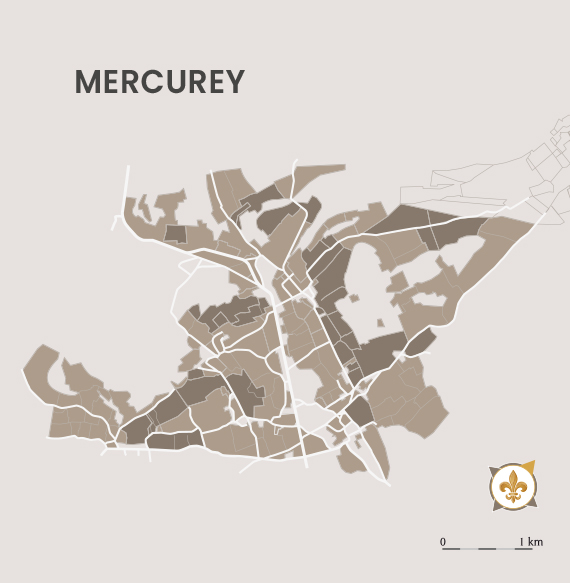
Mercurey is a local appellation in the north of the Côte Chalonnaise. It comprises 32 Climats classified as Premiers Crus and covers 650 hectares, including 545 hectares of reds (165 hectares of 1er Crus). The village owes its name to the Romans who, during their occupation of the region, built a temple to Mercury, the god of commerce and finance.
The vineyards, located between 230 and 320 metres above sea level, are situated on diverse geological terrain: marl and limestone to the east, Jurassic structure and crystalline bedrock to the west, with Bathonian soils. This rich variety of white limestone and red clay soils provides favourable conditions for vine cultivation.
Harvested by hand. The grapes are 100% destemmed. Vatting lasts 18 to 20 days. Maceration and fermentation take place at controlled temperatures. The cap is punched down twice a day during alcoholic fermentation. Malolactic fermentation is 100% complete.
Aged in oak barrels (20% of which are new) for around 12 months.
The year 2024 in Burgundy was marked by extreme weather conditions, including excessive rainfall and a significant lack of sunshine. These factors led to high disease pressure, particularly downy mildew, complicating the work of winegrowers. Episodes of frost and hail also caused substantial damage, especially in regions such as Chablis and the Auxerrois.
Yields were heavily impacted, with losses reaching up to 70% in certain areas. The Côte Chalonnaise proved more resilient, recording more limited losses. Overall, volumes are well below the usual average, reminiscent of the difficult 2021 harvest.
The late harvest required rigorous sorting to preserve quality. Despite the challenges, the harvested grapes reached excellent ripeness thanks to a sunny spell in September. The reds stand out for their richness and concentration, comparable to great vintages like 2010. The whites, characterized by their elegance, are reminiscent of the 2022 vintage.
Initial tastings reveal promising wines with concentrated aromas and fine structure. This vintage, though quantitatively limited, is shaping up to be a qualitative success.
 PDF file