


Pinot Noir.
Colour: Deep ruby red.
Bouquet: A powerful, complex nose, with aromas of black fruit and cherry mingling with animal, truffle and spice notes.
Palate: Rich, robust and compact, this wine remains round and flavoursome, with aromas of undergrowth, wild fruit and liquorice.
Serve with poultry and red meat, on exotic and spicy dishes. Also with ham and cockerel sauce, but also spring rolls, barbecued pork ribs. All these dishes will perfectly accompany this fruity and spicy wine.
Serve ideally at 14-16°C. (57-60°F.)
3 to 6 years after its vintage.
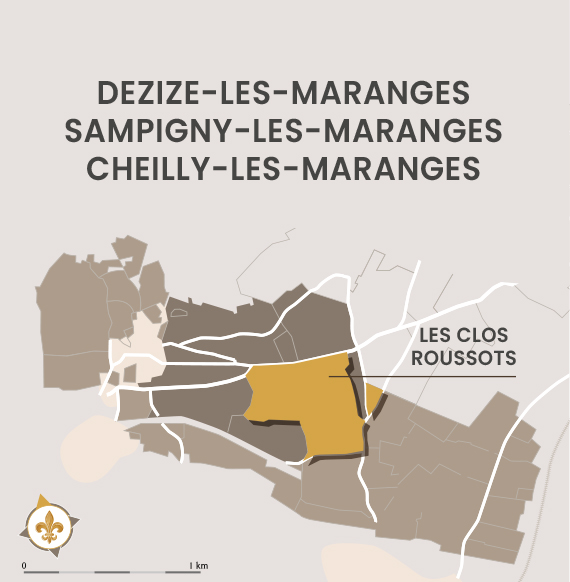
The Maranges vineyards form the link between the Côte-d'Or and the Saône-et-Loire. It is in perfect harmony with Santenay, with which it shares several esteemed crus. This village appellation in the south of the Côte de Beaune covers 190 hectares (177 ha of reds and 16 ha of whites), including 7 Premier Crus. 28 hectares make up the ‘Les Clos Roussots’ climat.
The vines stretch over the communes of Cheilly-lès-Maranges, Dezize-lès-Maranges and Sampigny-lès-Maranges. The most common exposure is south/south-east, at an altitude of between 240 and 400 metres. Cheilly has fairly light, stony soils. Sampigny and Dezize share the Climats of southern Santenay: brown limestone and limestone marl.
Grapes are harvested by hand and totally destemmed. Maceration lasts about 3 weeks. Traditional vinification is carried out in temperature-controlled concrete vats with regular stirring and pumpings-over.
Then, the wine is aged for 12 months in oak barrels with 30% new oak to bring the perfect touch of toasted aromas to the wine and its ripe tannins.
The year 2024 in Burgundy was marked by extreme weather conditions, with excessive rainfall and a significant lack of sunshine. These factors led to heavy disease pressure, particularly downy mildew, complicating the work of the winegrowers. Frost and hail also caused significant damage, particularly in regions such as Chablis and Auxerrois.
Yields were severely affected, with drops of up to 70% in some areas. The Côte Chalonnaise held up better, with more limited losses. Overall, volumes are well below the usual average, a reminder of the difficult harvests in 2021.
The late harvest necessitated rigorous sorting to preserve quality. Despite the challenges, the grapes harvested reached good ripeness thanks to a sunny spell in September. The reds stand out for their richness and concentration, comparable to great vintages such as 2010. The elegant whites are reminiscent of 2022.
Initial tastings reveal promising wines, with concentrated aromas and a fine structure. Although limited in quantity, this vintage promises to be a qualitative success.
 PDF file