


Pinot Noir.
Colour: A brilliant garnet red.
Nose: Red berry fruits (cherry), spices and a discreet woodiness.
Palate: An elegant wine, soft and pleasant, presenting a fat, strong attack with mature tannins. This is a supple, fine and elegant wine.
It will be the perfect companion to the traditional Burgundian dishes made with pinot noir sauce such as poached eggs « œufs en meurette », but also grilled lamb cutlets, donkey meat sausage, a spicy pizza, roasted beef or creamy cheese.
Serve ideally at around 15°C. (59°F.).
This wine can be enjoyed now or it can be kept for up to 2 to 4 years in optimal conditions.
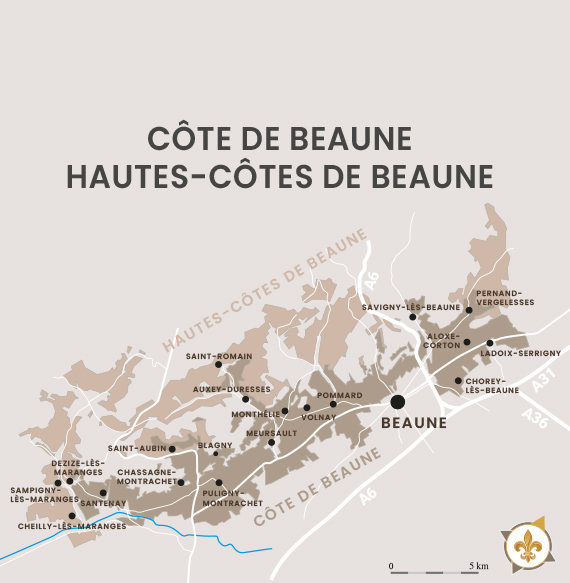
The area of the Côte de Beaune-Villages appellation spreads across 14 villages: Auxey Duresses, Blagny, Chassagne Montrachet, Chorey lès Beaune, Ladoix, Maranges, Meursault, Monthélie, Pernand Vergelesses, Puligny Montrachet, Saint-Aubin, Saint-Romain, Santenay, and Savigny lès Beaune. These villages can, for their red wines, choose to produce wine under their own appellation or under the Côte de Beaune-Villages appellation.
Brown limestone soil, with red stones, ferruginous oolites, yellow limestone, marls, clay, and sand. Varied slopes, often fairly inclined. South-eastern and southern exposure. Altitudes from 180 to 280 meters.
The harvest is picked by hand. The grapes are sorted out in the vineyard and at the arrival at the winery. They are crushed and destemmed before being macerated on a tank at a temperature of 8-10°C during 5 days (cold maceration). Then the alcoholic fermentation begins with punching down twice a day (during 2 weeks). The wine obtained is then aged for a part in stainless tank (70%) and the other part in barrel (30%) for 12 months.
The year 2024 in Burgundy was marked by extreme weather conditions, with excessive rainfall and a significant lack of sunshine. These factors encouraged high disease pressure, notably downy mildew, complicating the winemakers' work. Episodes of frost and hail also caused significant damage, particularly in regions like Chablis and the Auxerrois.
Yields were heavily impacted, with drops of up to 70% in certain areas. The Côte Chalonnaise resisted better, recording more limited losses. Overall, volumes are well below the usual average, reminiscent of the difficult 2021 harvests.
The late harvest required rigorous sorting to preserve quality. Despite the challenges, the harvested grapes reached great maturity thanks to a sunny period in September. The reds stand out for their richness and concentration, comparable to great vintages like 2010. The whites, elegant, are reminiscent of those from 2022.
Early tastings reveal promising wines, with concentrated aromas and a fine structure. This vintage, although quantitatively limited, promises to be a qualitative success.
 PDF file