


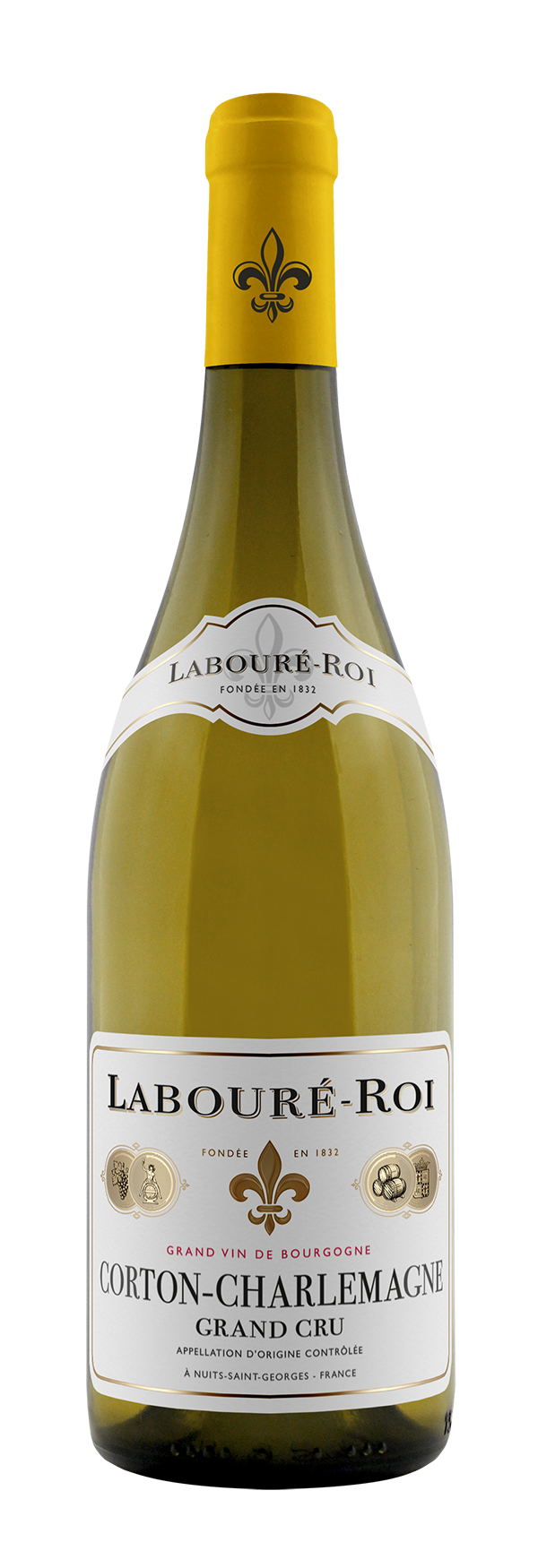
Chardonnay.
Colour: Pale gold with attractive green highlights.
Nose: Delicate bouquet revealing notes of baked apple, citrus fruit and honey, enhanced by a subtle mineral touch. With age, nuances of leather and truffle add further complexity.
Palate: Refined and complex, displaying remarkable balance. The flavour profile combines fruit, minerality, floral notes and honeyed nuances. A wine of great pedigree and outstanding character.
This Grand Cru pairs beautifully with Bresse chicken with morel mushrooms, grilled white meats, lobster, fine fish such as fugu or turbot, caviar, truffles, or rich and creamy cheeses such as Vacherin.
Best served at 13–14°C. (55–57°F.).
Under optimal cellar conditions, this great wine will age gracefully for 7 to 15 years.
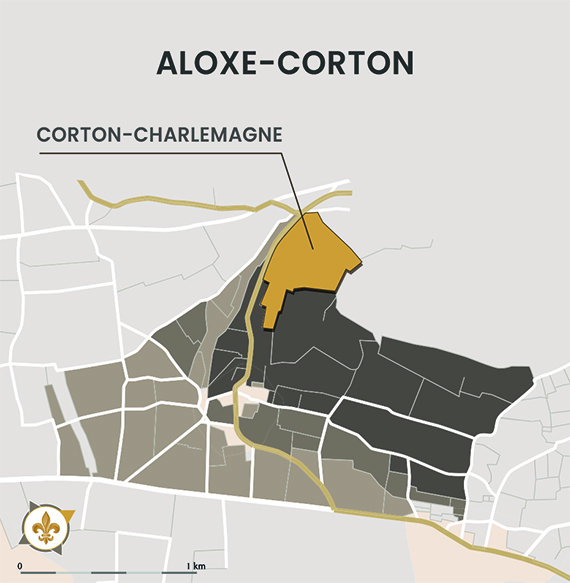
Among Burgundy’s most prestigious white wines, Corton-Charlemagne Grand Cru is distinguished by its position high on the slopes of the Corton hill in the Côte de Beaune. The appellation spans the three communes of Aloxe-Corton, Pernand-Vergelesses and Ladoix-Serrigny, benefiting from three distinct exposures. A large part of the appellation, situated within Pernand-Vergelesses, faces south-west; vineyards in Aloxe-Corton enjoy predominantly southern exposure; while those in Ladoix-Serrigny, together with part of Aloxe-Corton, face south-east. The vineyard lies on relatively steep slopes at elevations ranging from 280 to 330 metres above sea level.
The Chardonnay grapes undergo gentle whole-bunch pressing for approximately 2½ hours. The must is cooled to 12°C, then transferred directly into barrel without settling in order to retain the maximum amount of lees. Fermentation is long, lasting up to 10 months, followed by 18 months of ageing without racking and with no bâtonnage, thereby enhancing the wine’s mineral character. The wine is matured in 50% new oak, including 450-litre demi-muids, ensuring a more delicate oak influence and a purer expression of minerality.
The year 2024 in Burgundy was marked by extreme weather conditions, with excessive rainfall and a significant lack of sunshine. These factors led to heavy disease pressure, particularly downy mildew, complicating the work of the winegrowers. Frost and hail also caused significant damage, particularly in regions such as Chablis and Auxerrois.
Yields were severely affected, with drops of up to 70% in some areas. The Côte Chalonnaise held up better, with more limited losses. Overall, volumes are well below the usual average, a reminder of the difficult harvests in 2021.
The late harvest necessitated rigorous sorting to preserve quality. Despite the challenges, the grapes harvested reached good ripeness thanks to a sunny spell in September. The reds stand out for their richness and concentration, comparable to great vintages such as 2010. The elegant whites are reminiscent of 2022.
Initial tastings reveal promising wines, with concentrated aromas and a fine structure. Although limited in quantity, this vintage promises to be a qualitative success.
 PDF file