


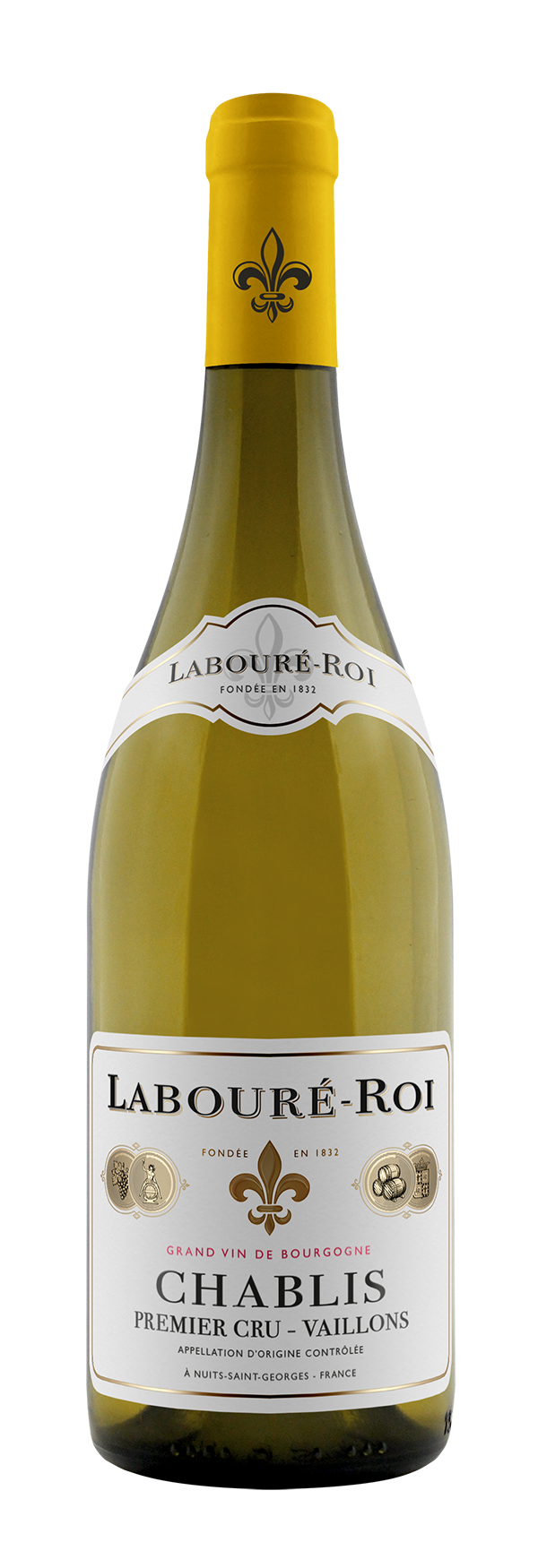
Chardonnay.
Visual: A very clear gold.
Nose: Exuberant, with aromas of vanilla and mocha coffee with exotic undertones.
Palate: Full-bodied and long on the palate, this wine offers vibrant notes of yellow fruits like pear and apricot, with a hint of honey on the finish. Lively and fleshy, it shows excellent aging potential.
This wine is excellent paired with smoked salmon, trout and other freshwater fish, as well as with white meats and creamy cheeses.
Serve ideally at a temperature of 12-14°C. (54-57°F.).
This wine can be enjoyed now or kept in the cellar for the next five years.
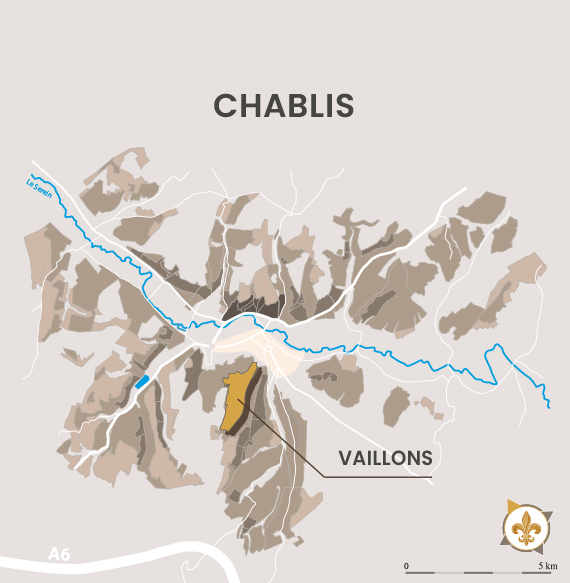
Chablis, situated near Auxerre in the Yonne department, is among the northernmost vineyards of Burgundy. The appellation has 40 climats classified as premiers crus, including 17 main ones. Located on the left bank of the Serein river, in the southwest of the Chablis region, the 105 hectares of Premier Cru Vaillons vines enjoy particularly favourable exposure and the wines are well deserving of their excellent reputation.
Latin provides the answer: etymologically, vallis or valles mean "a large space between two areas". Spelled "Valion" in a document dating from 1429, Vaillons ultimately derives its name from this notion of small valley.
The grapes were brought in as musts and underwent a slow pneumatic pressing followed by a very cold static settling before alcoholic fermentation, which lasted 10 days in temperature-controlled stainless steel tanks (18 to 20°C).
After 3 days, 15% of the juice was racked into barrels. Aged for 18 months on its lees, with frequent pumping over. 100% malolactic fermentation. Light filtration before bottling.
The year 2024 in Burgundy was marked by extreme weather conditions, with excessive rainfall and a significant lack of sunshine. These factors led to heavy disease pressure, particularly downy mildew, complicating the work of the winegrowers. Frost and hail also caused significant damage, particularly in regions such as Chablis and Auxerrois.
Yields were severely affected, with drops of up to 70% in some areas. The Côte Chalonnaise held up better, with more limited losses. Overall, volumes are well below the usual average, a reminder of the difficult harvests in 2021.
The late harvest necessitated rigorous sorting to preserve quality. Despite the challenges, the grapes harvested reached good ripeness thanks to a sunny spell in September. The reds stand out for their richness and concentration, comparable to great vintages such as 2010. The elegant whites are reminiscent of 2022.
Initial tastings reveal promising wines, with concentrated aromas and a fine structure. Although limited in quantity, this vintage promises to be a qualitative success.
 PDF file