


Chardonnay.
Colour: Very pale, clear with light green tints.
Bouquet: An elegant, racy nose showing notes of mandarins, fresh almond and dried apricot.
Palate: Rich and round in the mouth with elegant notes of acacia honey and citrus, good length and a finish that returns to mineral notes.
Will be perfect for all grand dishes such as lobster or grilled turbot, scallops, crayfish, sashimi, urchins, a creamy cheese and even caviar.
Ideally serve cooled down at 14°C / 57°F.
This Grand Cru wine can be laid down in a cellar for 5 to 7 years.
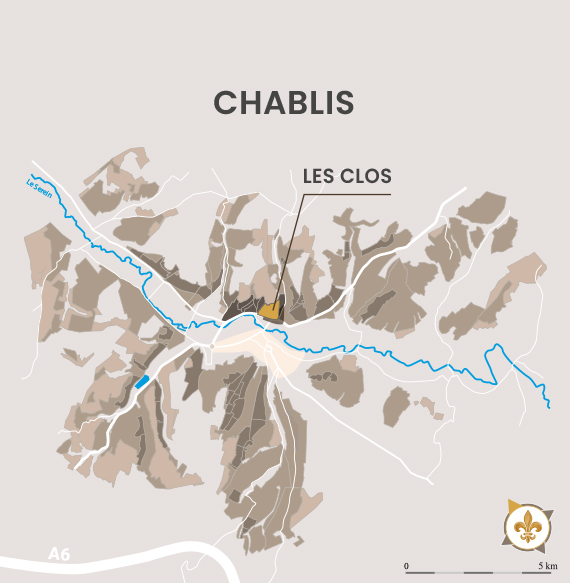
Chablis, near Auxerre in the Yonne department, is one of the northernmost vineyards in Burgundy. Located on the doorstep of Champagne and the Paris region, it has built a reputation exclusively on its white wines, produced on the slopes bordering the Serein valley, on rich Kimmeridgian soils.
‘Les Clos’ is the largest (24.75 hectares) and most homogeneous of the seven Grands Crus of Chablis. Located on a south-west facing hillside with a regular slope of around 200 metres, it rests on Portlandian colluvial soils and Kimmeridgian marl, giving the wines power and character.
The grapes were slowly pressed. The juice was left to settle at cold temperatures and the alcoholic fermentation began in stainless steel tanks. After 3 days, 30% of the juice was transferred to fine-grained oak barrels to continue the alcoholic fermentation. The remaining juice was left in stainless steel tanks for alcoholic fermentation under controlled temperatures (18-20°C / 64-68°F). The malolactic fermentation was completed. Finally, the wine was aged on its fine lees for 18 months.
The year 2024 in Burgundy was marked by extreme weather conditions, with excessive rainfall and a significant lack of sunshine. These factors led to heavy disease pressure, particularly downy mildew, complicating the work of the winegrowers. Frost and hail also caused significant damage, particularly in regions such as Chablis and Auxerrois.
Yields were severely affected, with drops of up to 70% in some areas. The Côte Chalonnaise held up better, with more limited losses. Overall, volumes are well below the usual average, a reminder of the difficult harvests in 2021.
The late harvest necessitated rigorous sorting to preserve quality. Despite the challenges, the grapes harvested reached good ripeness thanks to a sunny spell in September. The reds stand out for their richness and concentration, comparable to great vintages such as 2010. The elegant whites are reminiscent of 2022.
Initial tastings reveal promising wines, with concentrated aromas and a fine structure. Although limited in quantity, this vintage promises to be a qualitative success.
 PDF file