


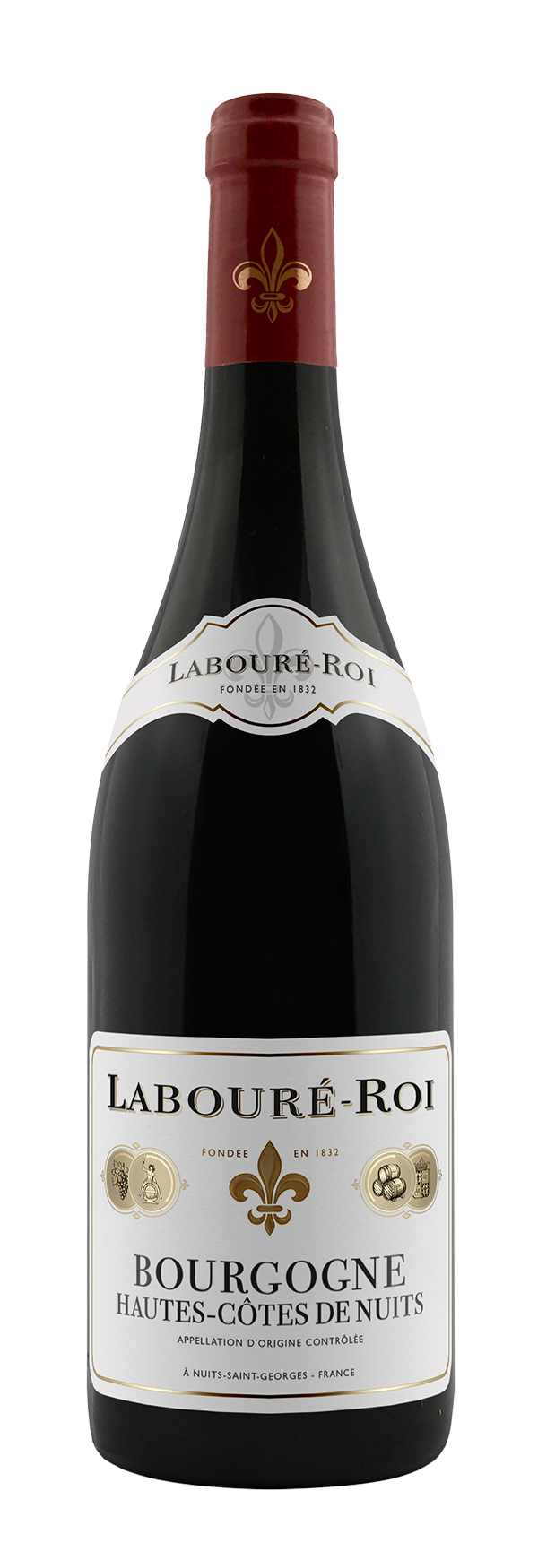
Pinot Noir.
Colour: bright ruby red.
Nose: nice typical notes of red and black fruit, slightly spicy (pepper).
Palate: elegant depth in the mouth. Fruity and animal flavors, silky tannins, smooth with a discreetly spicy finish, fresh and fruity. Good length on the palate.
Serve with grilled or roasted red meats, poached eggs in red wine sauce « oeufs en meurette », warm meat pie, or pasta. Can also be paired with game birds and cheeses.
Serve at a temperature of 15 °C. (59°F.)
This wine, which tastes well today, can be kept in good storage conditions for another 3 to 4 years.
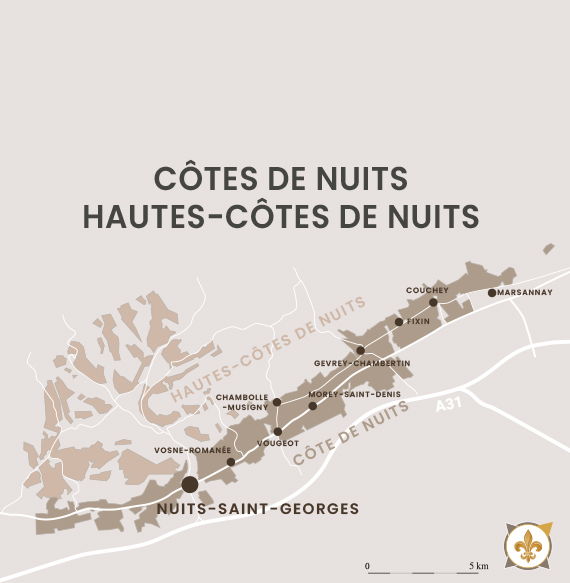
The vineyards of the Hautes-Côtes de Nuits are spread throughout the Côte de Nuits in Burgundy, from Dijon to Corgoloin. They cover the well exposed hills overlooking the Côte. The vineyards were rebuilt in 1950 in order to obtain a high quality wine. Pinot Noir and Chardonnay grape varieties were planted on its best slopes. All the efforts invested into enhancing quality are now bearing fruit. The vineyards cover a total surface of 570 hectares, for both white and red wines.
- Clay-limestone soil from the Jurassic period.
- South-eastern and southern exposure.
- Soft to steep slope.
- Altitude between 280 and 330 meters.
The grapes, harvested mechanically or manually (with destemming), undergo cold maceration for two days at 8-10°C to extract the aroma compounds, colouring matter and body of the wine. Fermentation lasts around ten days with daily pumping over and punching down. Ageing, partly in barrels (25% new) and partly in vats, continues for 8 to 9 months, including malolactic fermentation. Finally, the two parts are blended before bottling.
The year 2024 in Burgundy was marked by extreme weather conditions, with excessive rainfall and a significant lack of sunshine. These factors led to heavy disease pressure, particularly downy mildew, complicating the work of the winegrowers. Frost and hail also caused significant damage, particularly in regions such as Chablis and Auxerrois.
Yields were severely affected, with drops of up to 70% in some areas. The Côte Chalonnaise held up better, with more limited losses. Overall, volumes are well below the usual average, a reminder of the difficult harvests in 2021.
The late harvest necessitated rigorous sorting to preserve quality. Despite the challenges, the grapes harvested reached good ripeness thanks to a sunny spell in September. The reds stand out for their richness and concentration, comparable to great vintages such as 2010. The elegant whites are reminiscent of 2022.
Initial tastings reveal promising wines, with concentrated aromas and a fine structure. Although limited in quantity, this vintage promises to be a qualitative success.
 PDF file