


Chardonnay.
Colour: A beautiful golden colour.
Nose: Very expressive, almost exuberant and very seductive, with woody notes and hints of vanilla. A trace of honey, white flowers and citrus notes.
Palate: Delicate and perfumed, well-balanced and round. Its meatiness and woodiness come from the time spent maturing in oak casks.
This wine pairs beautifully with steamed fish, crustaceans, and Burgundian classics like ham with parsley (jambon persillé) and snails. When fully matured, it complements delicacies such as salted goose liver (foie gras au sel) and French cheeses like Roquefort, Aisy cendré, mature Comté, and Chaource.
Ideally served at a temperature of around 12°C (54 °F).
This wine can be drunk now or laid down for around 3 to 5 years.
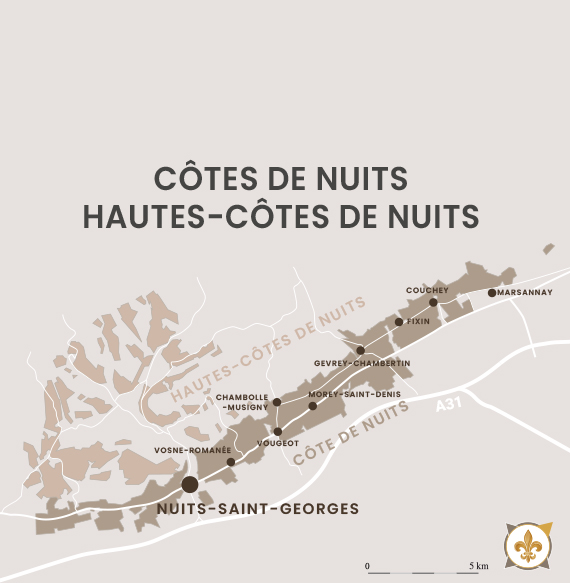
A regional appellation covering 20 communes in the Côte d'Or. Overlooking the coast from Gevrey-Chambertin to the Bois de Corton, the Hautes Côtes de Nuits are steeped in wild beauty. Discover the small villages nestling on the edge of the forests. Vines grow on all the well-exposed slopes, proudly guarding the secrets of their noble heritage, inherited from Vergy and the Abbey of Saint-Vivant. This vineyard is situated at an altitude of between 300 and 400 metres. The vines grow on the slopes of the valleys incising the Jurassic limestone plateaux to the west of ‘la côte’. The substratum is identical to that of the coast, but the surface formations are very thin, or even non-existent. The clay-limestone soils result from the alteration of the limestone and marl of the substratum.
Once the grapes had been sorted and destemmed, the must was extracted by pneumatic pressing, then cooled and left to settle for 24-48 hours. The juice was then brought down to 18°C to start the alcoholic fermentation (which lasted 3 weeks) in temperature-controlled stainless steel vats. Part (40%) of the cuvée was then placed in barrels (15% new) for 8 months' ageing before final blending. Light filtration before bottling.
The year 2024 in Burgundy was marked by extreme weather conditions, with excessive rainfall and a significant lack of sunshine. These factors led to heavy disease pressure, particularly downy mildew, complicating the work of the winegrowers. Frost and hail also caused significant damage, particularly in regions such as Chablis and Auxerrois.
Yields were severely affected, with drops of up to 70% in some areas. The Côte Chalonnaise held up better, with more limited losses. Overall, volumes are well below the usual average, a reminder of the difficult harvests in 2021.
The late harvest necessitated rigorous sorting to preserve quality. Despite the challenges, the grapes harvested reached good ripeness thanks to a sunny spell in September. The reds stand out for their richness and concentration, comparable to great vintages such as 2010. The elegant whites are reminiscent of 2022.
Initial tastings reveal promising wines, with concentrated aromas and a fine structure. Although limited in quantity, this vintage promises to be a qualitative success.
 PDF file