


Pinot Noir.
Colour: A beautiful, deep ruby colour with rich, intense hues.
Nose: Complex and refined, revealing aromas of crunchy cherry, blackberry and blackcurrant, complemented by delicate notes of oak and vanilla.
Palate: Generous and silky, with an elegant texture, beautifully integrated tannins and a long finish lingering on black fruit flavours.
Best enjoyed with dishes prepared in a wine-based sauce, such as marinated red meat or chicken with morels. It also pairs beautifully with a fine selection of cheeses, particularly those with a strong character.
Serve ideally between 15°C and 17°C (59°F–63°F).
Under suitable cellar conditions, this wine will age gracefully for up to 8 years, or even longer.
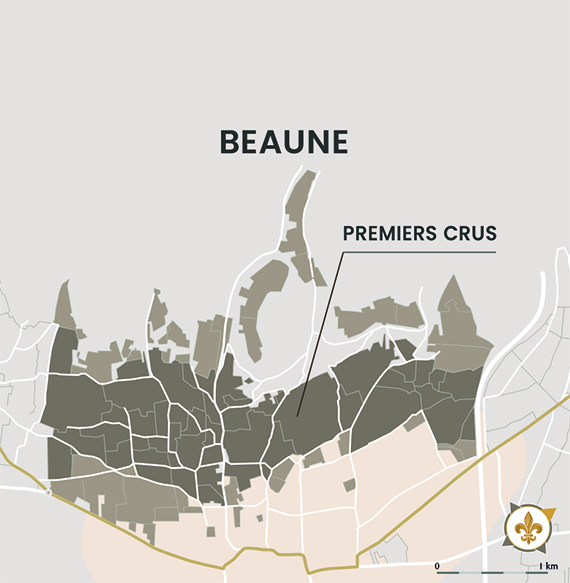
Located in the heart of Burgundy’s vineyards, Beaune is one of the region’s most emblematic appellations. The appellation covers nearly 450 hectares, spread across 41 climats, a large proportion of which are classified as Premier Cru vineyards. The rich and varied soils—limestone, marl, clay and sand—combine with pronounced slopes facing south and south-east, at elevations ranging from 190 to 380 metres.
Beaune, whose name derives from the Gallic god Belenus, has embodied the very essence of Burgundy wine culture for centuries.
The grapes are harvested by hand and carefully sorted in the vineyard before undergoing a second selection in the winery on a sorting table. The berries are then 100% destemmed but not crushed, and transferred whole into wooden vats by gravity. Maceration lasts approximately three weeks, with regular punch-downs throughout the process. No oenological additives are used, ensuring the purity and authenticity of this precious terroir are fully preserved. The wine is matured for 16 months in oak barrels, without racking, including 30% new oak.
This vintage has been particularly challenging for winegrowers and winemakers. It began with very warm temperatures at the end of February, leading to an early restart for the vines, followed by a historic frost in April which had a severe impact on the young shoots. From May to mid-August, incessant rain kept winegrowers on their toes, despite a favourable flowering period and a veraison facilitated by the return of sunshine from mid-August.
These capricious weather conditions encouraged the appearance of disease outbreaks, necessitating rigorous sorting of the fruit to preserve quality.
The winemaking process was highly technical, with particular attention paid to extracting the colouring matter and structural balance from the red wines, and to the freshness, acid balance and aromatic potential of the white wines. From the very first tastings, the vintage has revealed a lovely aromatic potential, with less sun-drenched, moderate wines, with a diverse range of flavours and textures that will assert their uniqueness.
 PDF file