


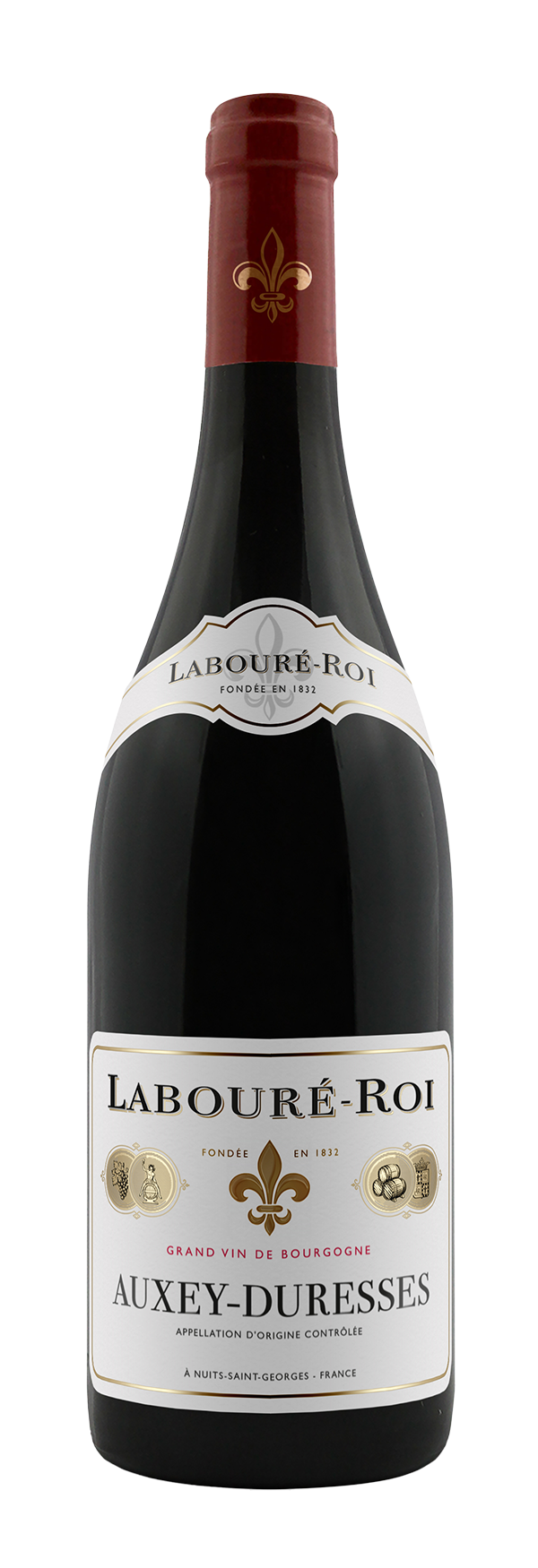
Pinot Noir.
Colour: brilliant ruby red.
Nose: typical Pinot finesse, with aromas of red berries and hints of liquorice.
Palate: lacy on the palate, with elegant tannins, great finesse and perfect balance.
Enjoy it with grilled white meats, roast chicken, pork filet mignon, stir-fried veal or rack of lamb. It will also be perfect with a fine plate of fine charcuterie and soft, creamy cheeses.
Serve ideally at a temperature of around 14-15°C. (57-59°F.).
Drink from now and can be kept in the cellar for 4 to 7 years.
The village of Auxey-Duresses lies on the threshold of a valley that runs from the Côte de Beaune into the Hautes-Côtes de Beaune on the way to La Rochepot, with its emblematic glazed-tile castle, and the Morvan region.
Nestling back from the two flagship communes of Volnay and Meursault, the vineyard covers just 170 hectares, 130 of which are given over to red wines.
The vineyards are planted on very stony, marl-limestone soils, facing east and south-east on steep slopes at an average altitude of 250 metres.
The grapes are harvested by hand and sorted manually on arrival at the winery. All the grapes were de-stemmed. Cold maceration follows for 4 days at 8° to 10°C. (46-50°F). Then, 15 days of alcoholic fermentation with regular punching down and pumping over (twice a day). Selected yeast used.
Ageing in 100 % Burgundian oak barrels of 228 litres with 25% of news one. After 12 months of maturing process, the wine is racked and delicately filtrated for bottling.
The year 2024 in Burgundy was marked by extreme weather conditions, with excessive rainfall and a significant lack of sunshine. These factors encouraged high disease pressure, notably downy mildew, complicating the winemakers' work. Episodes of frost and hail also caused significant damage, particularly in regions like Chablis and the Auxerrois.
Yields were heavily impacted, with drops of up to 70% in certain areas. The Côte Chalonnaise resisted better, recording more limited losses. Overall, volumes are well below the usual average, reminiscent of the difficult 2021 harvests.
The late harvest required rigorous sorting to preserve quality. Despite the challenges, the harvested grapes reached great maturity thanks to a sunny period in September. The reds stand out for their richness and concentration, comparable to great vintages like 2010. The whites, elegant, are reminiscent of those from 2022.
Early tastings reveal promising wines, with concentrated aromas and a fine structure. This vintage, although quantitatively limited, promises to be a qualitative success.

 PDF file