


Pinot Noir.
Colour: Nice dark cherry red, bright, intense and limpid.
Nose: A very elegant bouquet offering sour cherry and blackcurrant aromas carried by undergrowth notes.
Palate: In the mouth, the wine is nervous, robust with red fruits flavors dominated by candied cherry notes. The finish shows a delicate woody structure and soft tannins with a hint of liquorice.
Its generous, opulent character and distinguished tannins are the perfect accompaniment to red meat, grilled or in sauce, and roast or glazed poultry. Not forgetting, of course, soft, washed-rind cheeses such as Époisses, Ami du Chambertin and Livarot.
Serve ideally at 16-17°C. (60-63°F.)
This great wine can be enjoyed now or kept up to 7-8 years after the vintage in good cellaring conditions.
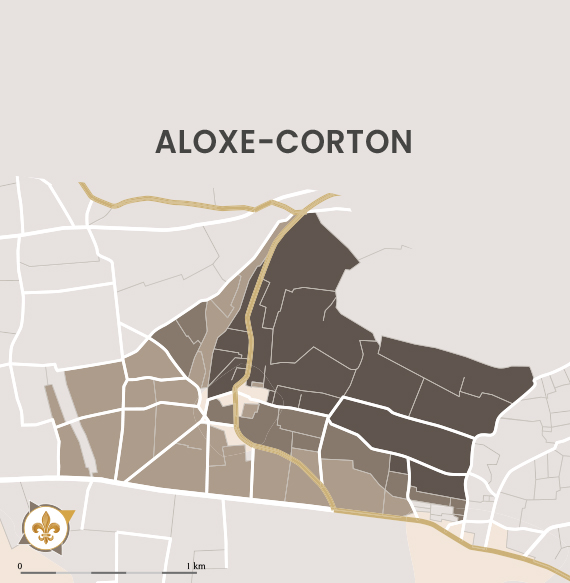
Situated in the north of the Côte de Beaune, the Aloxe-Corton appellation covers both the village of the same name and part of Ladoix-Serrigny. Nestling at the foot of the Corton mountain, the commune of Aloxe-Corton boasts two Grands Crus, Corton and Corton-Charlemagne, and 14 climats classified as Premiers Crus.
The surface area of the Aloxe-Corton AOC is 120 ha, with only 1.5 ha in white; 36 ha of this appellation are Premiers Crus.
The soil of the Aloxe-Corton appellation is stony, chalky and marly in the upper part of the appellation, more clayey with residues of flinty limestone in the lower part.
Hand-picked, the grapes undergo a pre-fermentation cold maceration for 4 to 5 days, at a temperature maintained between 10 and 14°C. Then comes the alcoholic fermentation with selected yeasts, punching of the cap and daily pumping over.
The wine is aged 100% in oak barrels, with around 20% new barrels, for around 16 months.
The year 2024 in Burgundy was marked by extreme weather conditions, with excessive rainfall and a significant lack of sunshine. These factors led to heavy disease pressure, particularly downy mildew, complicating the work of the winegrowers. Frost and hail also caused significant damage, particularly in regions such as Chablis and Auxerrois.
Yields were severely affected, with drops of up to 70% in some areas. The Côte Chalonnaise held up better, with more limited losses. Overall, volumes are well below the usual average, a reminder of the difficult harvests in 2021.
The late harvest necessitated rigorous sorting to preserve quality. Despite the challenges, the grapes harvested reached good ripeness thanks to a sunny spell in September. The reds stand out for their richness and concentration, comparable to great vintages such as 2010. The elegant whites are reminiscent of 2022.
Initial tastings reveal promising wines, with concentrated aromas and a fine structure. Although limited in quantity, this vintage promises to be a qualitative success.
 PDF file